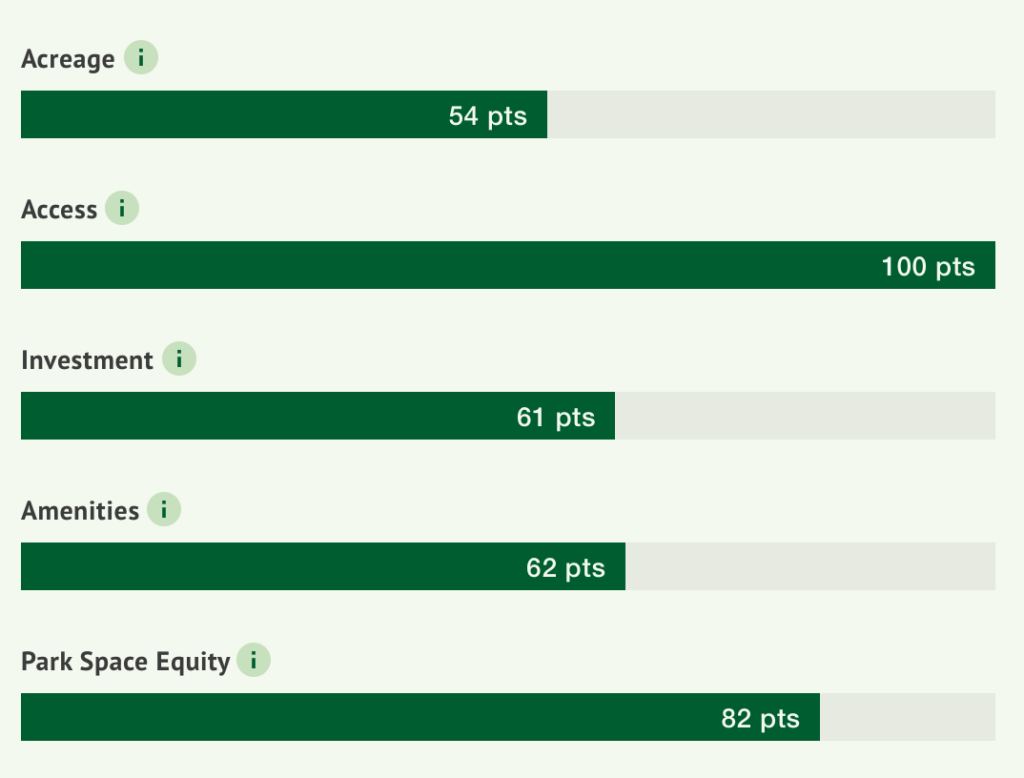
According to the 2026 Trust for Public Land’s annual ParkScore Index, Boston is in 12th place among the 100 most populated US cities in terms of its park system. The Index reflects scores “in five categories reflective of an excellent city park system: access, investment, amenities, acreage, and equity. While the rankings provide fodder for friendly competition, the goal each year of publishing the index is to help leaders advocate for needed park resources and provide relevant data to inform local park improvement efforts. To facilitate a fair comparison across cities, the index aggregates across all public and private organizations supporting parks in each city.”
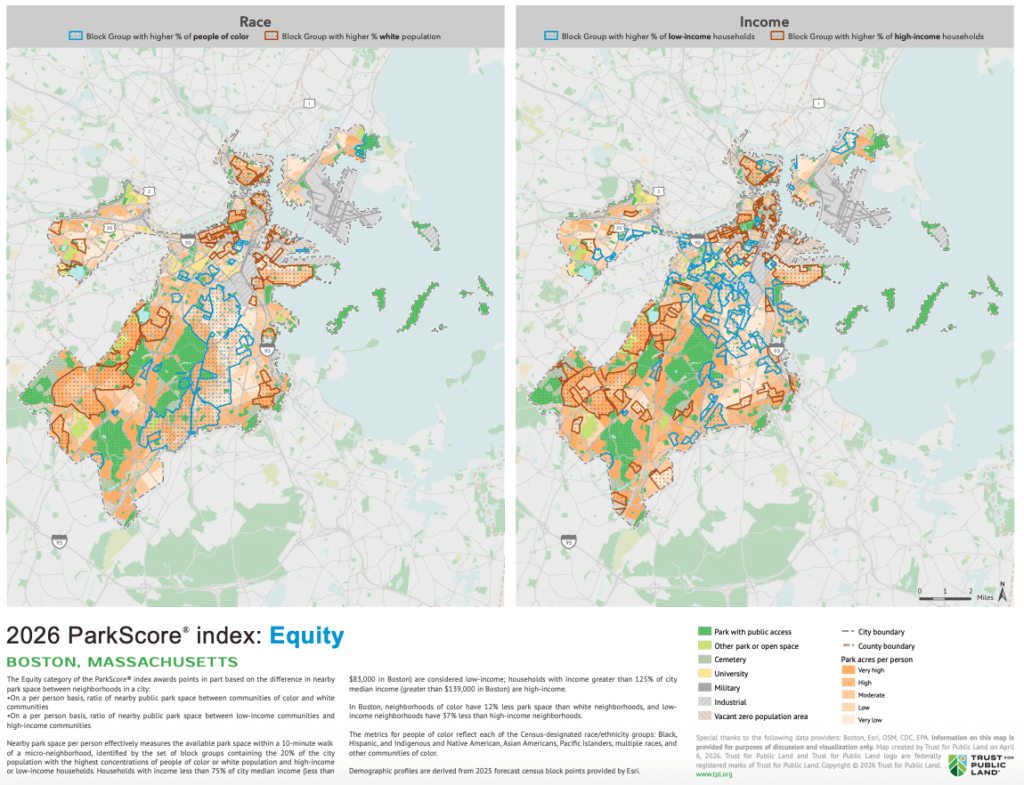
TPL’s Associate Vice President and MA State Director Jodi Valenta writes for WBUR’s Cognoscenti newsletter that Boston maintained its 12th spot from last year. “Today, 100% of the city’s residents live within a 10-minute walk of a park. But not all parks in Boston serve the surrounding community equally. Boston residents in low-income neighborhoods have access to 16% less park space per person than residents of average-income Boston neighborhoods, and 25% less than residents of high-income neighborhoods, reflecting gaps in access to outdoor spaces that support health, connection and quality of life.
This matters because at a time when cities are balancing competing priorities and limited resources, parks represent an investment that delivers multiple benefits,” Valenta emphasizes.
In addition, “New research by TPL shows that there is a $3 return in economic benefits, on average, for every dollar invested in parks and recreation each year, from lower healthcare costs to stronger local economies. Additional benefits include reduced stormwater treatment costs, improved public health outcomes, consumer savings on fitness and recreation, higher tax revenues and a boost in public-private partnerships.
These are not new ideas. More than a century ago, Frederick Law Olmsted argued that parks were not luxuries, but public necessities — places where people could restore their minds and bodies, connect with one another and improve public health. His vision reshaped American cities and remains just as relevant today.
That same belief guided President Theodore Roosevelt and Gifford Pinchot, an American politician and forester who fought powerful industrial interests to protect forests and public lands for future generations. They helped establish a uniquely American idea: that some places should belong to everyone because they serve the public good. Today, urban parks carry that same promise. As our communities become denser and our lives increasingly move indoors, access to nature isn’t a luxury — it’s essential infrastructure.
And when access to that infrastructure improves, behavior follows. People living within a 10-minute walk of a park are more than twice as likely to spend 20 minutes in nature most days of the week compared to those who don’t. They’re also 35% more likely to get the recommended 150 minutes a week of physical activity than those who don’t.
According to a new survey by the National Association of Realtors, more than 100 years after Olmsted’s death, Americans rate access to parks as a top priority when searching for a new home.”
Read the report in full.
Data from the 2026 Boston ParkScore Index: