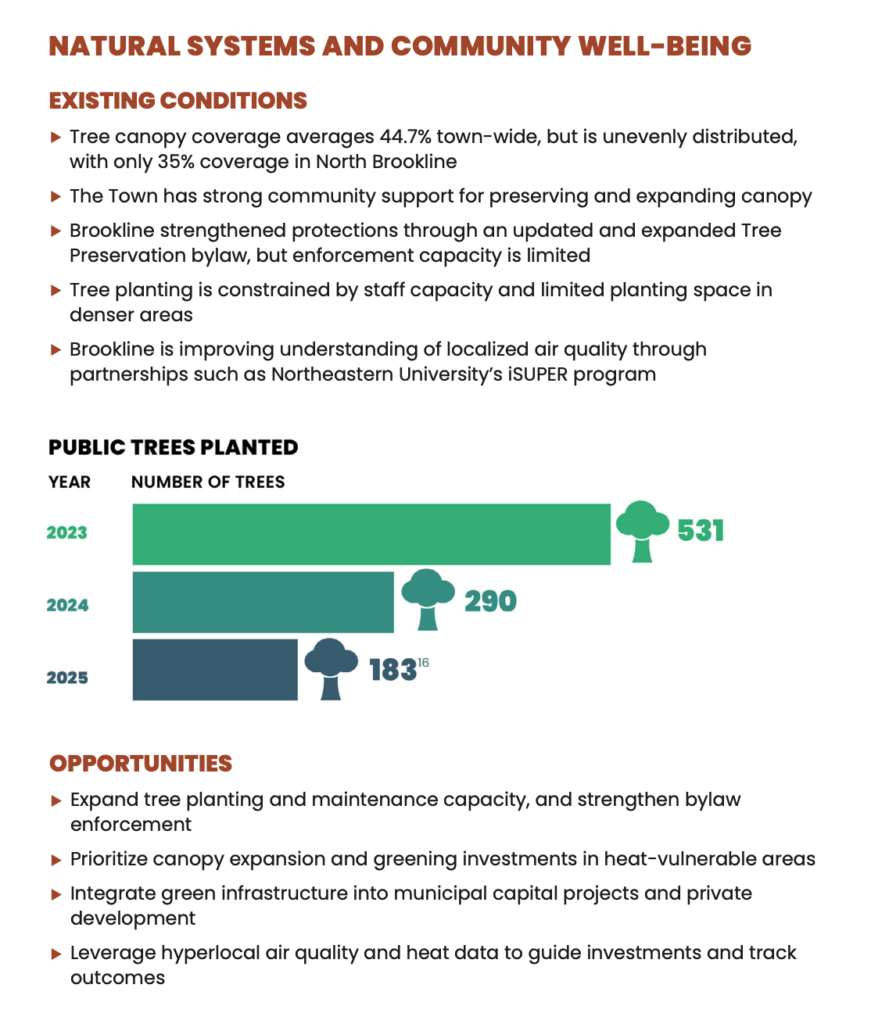
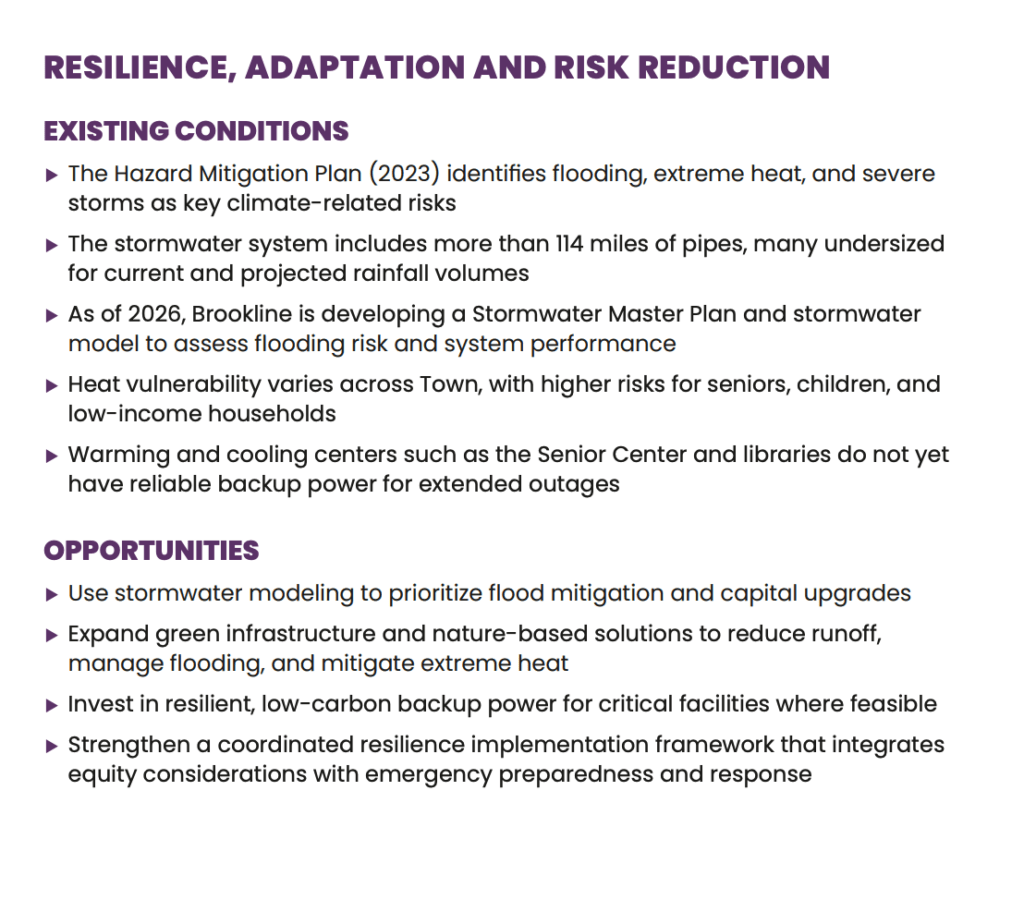
The new framework for climate resiliency (CARP) for the Town of Brookline includes 45 strategies and 178 actions spanning Buildings & Energy, Resource Conservation & Management, Sustainable Transportation & Mobility, Natural Systems and Community Wellbeing, and Resilience, Adaption & Risk Reduction. To keep the community informed every step of the way, Brookline DPWorks has launched a Climate Action Implementation Tracker, a public dashboard where you can follow the Town’s progress toward the goal of net-zero emissions by 2050.
The Climate Vulnerability Assessment section reports:
“Brookline completed a comprehensive Climate Vulnerability Assessment in 2017 to evaluate the Town’s exposure to and risks from climate change. Prepared by the Metropolitan Area Planning Council, the assessment examined projected impacts from flooding, extreme heat, and drought, and evaluated how these hazards affect public health, infrastructure, natural resources, and the local economy. The analysis identified flooding and extreme heat as the Town’s most significant near-term climate risks, with particular concern for low-lying areas near the Muddy River — prior to completion of the Muddy River Flood Risk Management Project — and densely developed neighborhoods in North Brookline with limited tree canopy. It also highlighted that vulnerable populations — including older adults, low-income residents, and those with limited English proficiency — are likely to experience disproportionate impacts. The assessment emphasized the need to improve stormwater management, expand urban tree canopy, enhance emergency preparedness, and strengthen coordination across Town departments.
These findings and recommendations have informed subsequent planning efforts, including the Urban Forest Climate Resiliency Master Plan and Hazard Mitigation Plan.”
Among the CARP’s strategies for enhancing natural systems and community well-being:
- Increase the urban tree canopy coverage
- Protect existing private trees and incentivize planting of new trees on private properties
- Increase green infrastructure in municipal capital projects
- Increase site-scale green infrastructure and expanded canopy in private development
Among the CARP’s strategies for enhancing resilience, adaptation and risk reduction:
- increase climate resilience to stormwater flood risk
- Improve urban heat island strategies on public properties
- Improve climate preparedness for individuals, families, and households by educating people on climate mitigation and adaptation
- Reduce municipal, residential, and commercial water use by 15 percent and adopt a drought preparedness plan
Read the full CARP.