
By Abby Oliveira, Senior Land Use and Sustainability Planner for the Longwood Collective
One year ago, we broke ground on the Longwood Medical and Academic Area’s (LMA) first-of-its-kind bioswale at the corner of Avenue Louis Pasteur and The Fenway. After years of collaborative planning with the City of Boston, Boston Water and Sewer Commission and support from the City’s Edward Ingersoll Browne Fund, the three-year pilot project installation is now fully operational.
Today, it captures and filters stormwater, supports resilient vegetation, reduces polluted runoff, and provides a home for five thriving new street trees. More than just a stormwater management system, the bioswale is a living demonstration of how green infrastructure can transform an urban streetscape while strengthening climate resilience.
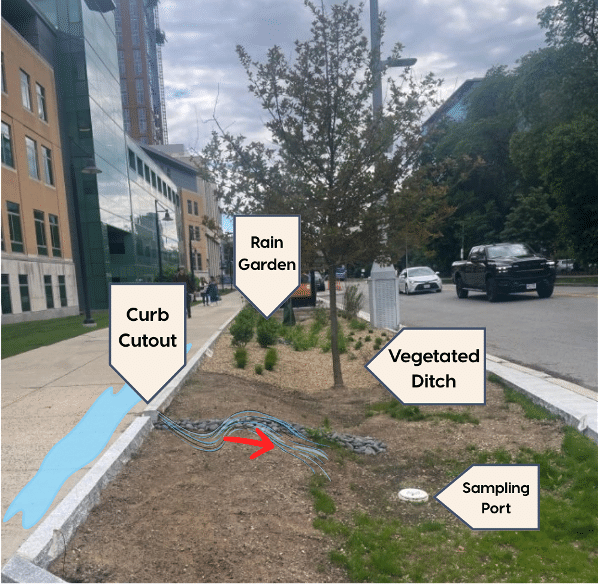
By slowing, filtering, and absorbing rainfall before it enters local waterways, the project helps improve overall water quality and reduces pressure on the city’s drainage system during storm events. Its impact will also extend beyond the installation itself by helping us better understand how green infrastructure can perform in a dense, highly active urban environment.
We are proud to collaborate with students and professors from Simmons University and Northeastern University to sample and analyze soil and water quality, harnessing the knowledge and the rigorous research skills of our local institutions. These studies, combined with water volume data gathered by stormwater experts at the Charles River Watershed Association, will help us to understand the effectiveness of the system and inform future local planning for similar green infrastructure projects across Longwood. Testing is ramping up this fall, and we look forward to sharing initial findings later this year.
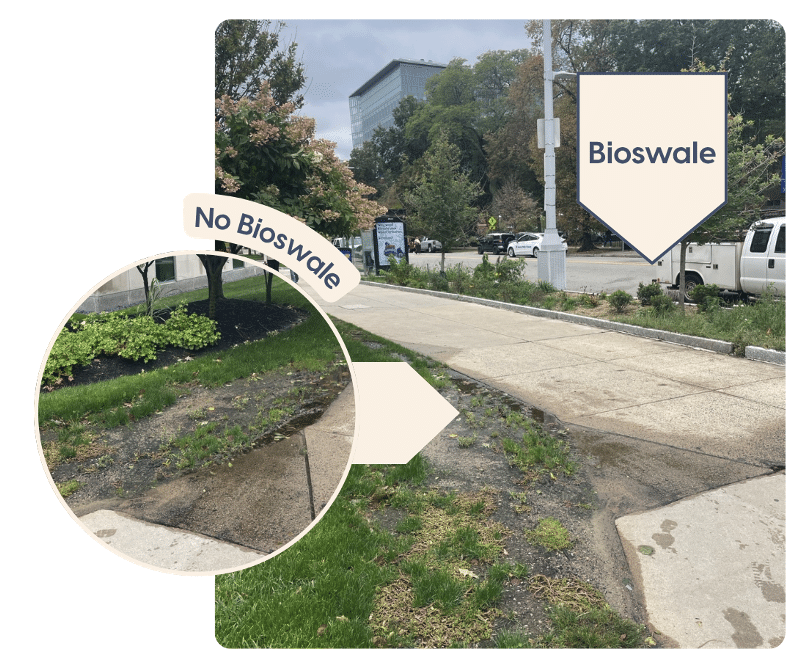
This past weekend’s nor’easter put the bioswale to the test, and within 24 hours after the storm, the systems had effectively filtered all stormwater, reducing sidewalk and street flooding.
This work is part of Longwood Collective’s broader commitment to creating a greener, more resilient neighborhood. That commitment took another significant step forward in October 2025 with the publication of the Open Space and Resilience Framework, which identifies strategies for adapting Longwood to the growing challenges of extreme heat and flooding. Our work to advance green infrastructure earned recognition in the City of Boston’s 2030 Climate Action Plan and helped establish a partnership focused on using Longwood as a living laboratory for climate resilience solutions.
Home to 73,000 employees and some of the world’s leading institutions in healthcare, research, and education, Longwood offers a unique environment to test approaches that could have applications well beyond the district. The bioswale demonstrates how partnerships, planning and a shared commitment to the environment can make Longwood and Boston healthier, more vibrant and more resilient places.
The installation also builds on Avenue Louis Pasteur’s historic role as a gateway to the Emerald Necklace park system. Designed in the early 1900s with linden trees lining its edges, the streetscape has been in decline for decades due to soil compaction, pollution, and road salt. Today, just 11 of the original trees remain.
By replacing four declining trees with five new ones and integrating a surface-level raingarden and below-grade filtration system, the project honors the historic character of the corridor while strengthening its resilience for the future. Stormwater is captured, absorbed, and filtered through the plantings, with excess water flowing into the Muddy River—helping restore ecological health to the broader watershed.
One year after breaking ground, the bioswale is demonstrating how thoughtful, collaborative interventions in green infrastructure can contribute to a more resilient district and city.